
Philosophical Astrology
Buddhist and Hindu Astrology: The Sri Lankan Synthesis
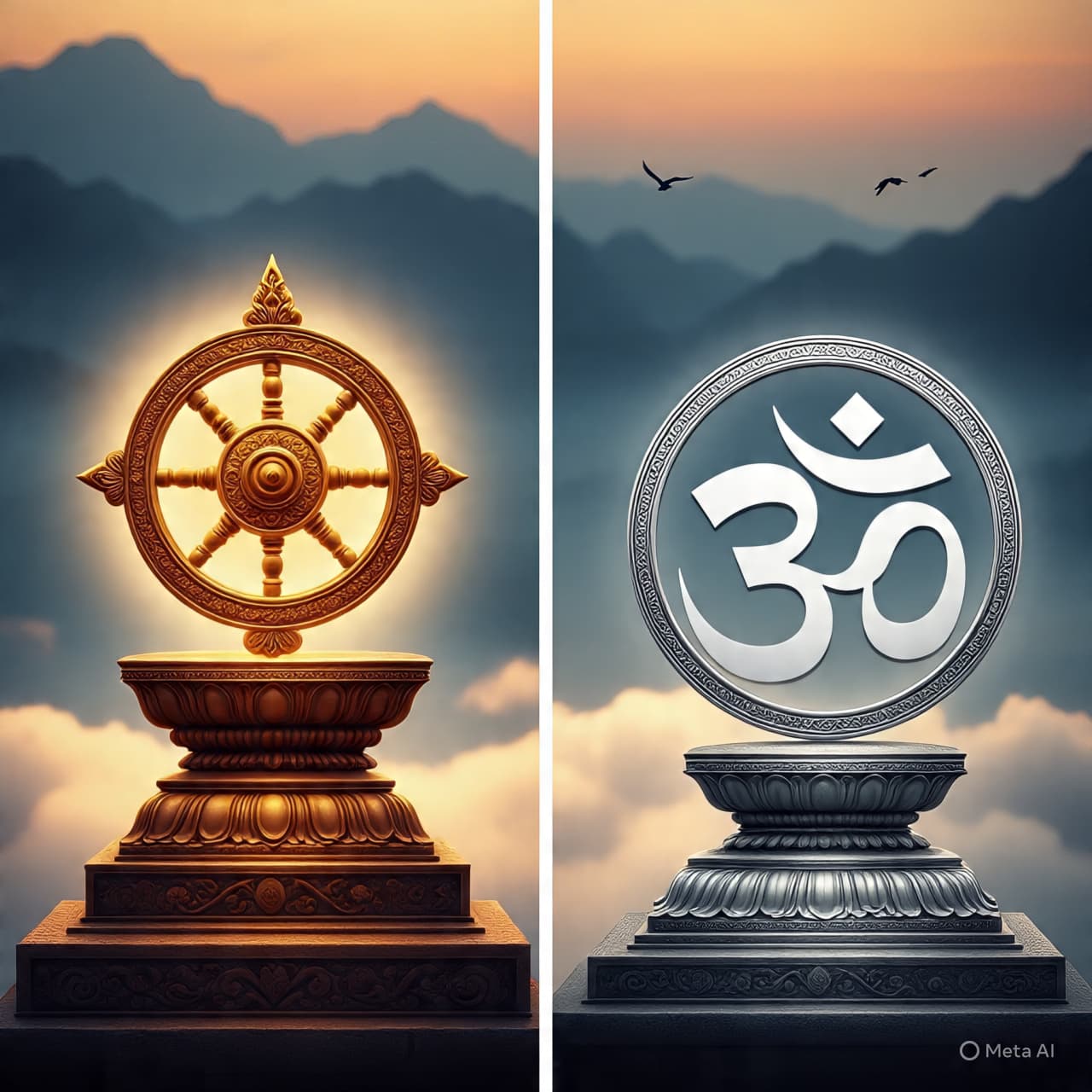
I am often asked whether astrology contradicts the Buddha's teaching. It is a fair question, and one I have thought about for most of my life. The Buddha spoke of a mind free from clinging, of results that follow from our own actions, of a path walked step by step. Astrology, at first glance, seems to say the opposite: that the stars have already decided. If a person's life is written in the sky, what room is left for effort, for choice, for the slow work of becoming a better human being?
The answer, as I have come to understand it over many years at the writing desk with a client's chart open before me, is that the two never truly quarrelled. In Sri Lanka they grew up side by side, and out of that long companionship something quiet and particular took shape. Our jyothishaya carries the mathematics and the planetary craft of the Vedic tradition, but it reads the result through a Buddhist heart. That difference of heart changes everything.
Two Traditions, One Island
The calculating methods we use — the placement of the grahas, the nakshatra systems, the timing of the dashas — came to us from the Vedic tradition of the mainland, carried across by traders, scholars, and the movement of learning over many centuries. I make no claim to have invented anything; the arithmetic in a kendara today would be recognised by an astrologer of long ago. What we inherited was a precise and demanding technique, and it has served the island faithfully.
But Sri Lanka was, and is, a Buddhist land, and Buddhism did not simply sit beside these older practices. It reshaped how they were understood. Where one older view might treat the planets as deities whose favour must be won through elaborate ritual, and a person's circumstances as a debt owed from past lives that must be paid, the Buddhist mind hears something gentler in the same chart. A planet is not a master issuing commands. It is a marker of tendency, of inclination, of the ground a person is standing on when they begin this life. What they do from that ground remains theirs to decide.
This is the heart of the matter, and I want to be careful with it, because it is easy to misstate. Buddhism does not deny karma — it is built upon it. The Buddha taught that our present conditions arise from a web of causes, our own past intentions and actions among them. A horoscope, read in this light, is a description of karma already ripening: the shape of the field we have been given to work. What it is not is a sentence handed down that we are powerless to answer.
Karma Is Not the Same as Fate
Here I must draw the line clearly, because the confusion between karma and fatalism has done real harm. Fatalism says the future is fixed and nothing you do will change it. That is not karma, and it was never the Buddha's teaching. Karma is dynamic. It is the principle that intention and action have consequences — which is precisely why the present moment matters so much. If everything were already settled, ethical effort would be pointless, and the whole of the Buddha's path would collapse into a cruel joke. He plainly did not think so.
So when I sit with a young man whose chart shows a difficult period ahead, I do not tell him his fate is sealed. I tell him what the tendencies of that period are, so that he can meet them with his eyes open. The chart, understood well, is not a cage. It is closer to a weather forecast for the inner life: it tells you the season you are entering, and leaves the walking to you. The Middle Path teaches me to avoid two errors here — the error of pretending the weather does not exist, and the error of believing the weather owns you.
Within that space between the two errors lives free will, and it is not a small space. A person can meet a hard planetary period with resentment and grasping, and deepen their suffering, or meet it with steadiness and generosity, and lighten it. I have watched both happen many times. The stars incline; they do not compel. The old teachers put it plainly, and nothing in my experience has contradicted them.
How This Shapes the Way I Advise
Because I read a chart this way, the counsel I give tends to differ from a purely predictive style of consultation. I try never to frighten a person with a prophecy, and never to flatter them with false comfort. Both are forms of untruth, and the tradition I stand in prizes honest, compassionate speech above a dramatic reading. My task is not to announce what will happen but to help someone see clearly and choose wisely.
The remedies I recommend follow from the same conviction. Where an older approach might reach first for costly ceremonies and gemstones to appease a planet, I place greater weight on what a person can cultivate within themselves, because that is where lasting change actually lives. This does not mean I discard the traditional elements — a gemstone, a mantra, a visit to the temple all have their place, and I use them. But I understand them as supports for inner work rather than transactions that buy off a graha. The most reliable remedies I know are these:
- Generous giving (dana), ethical conduct (sila), and the cultivation of mind through meditation (bhavana) — the three that the Buddha named as the ground of merit, and which I have seen change the texture of a person's life more surely than any stone.
- The steady practice of loving-kindness, especially for those in difficult relationships or facing a period the chart marks as strained.
I offer these not as magic against the planets but as the genuine work of a life. A calmer, kinder, more disciplined mind meets every planetary season differently, and that changed meeting is itself the transformation the tradition points toward.
The Same Wisdom, Applied
You can see this outlook wherever our astrology touches daily life. When I prepare a kendara for a newborn, I am not fixing the child's destiny in ink; I am giving the family a thoughtful map of tendencies to nurture and watch. When two families come to me for porondam before a marriage, the compatibility count matters, but I speak just as much about temperament, patience, and the willingness of two people to grow toward each other. The mathematics opens the conversation. Wisdom and honesty carry it the rest of the way.
I do not pretend this synthesis is unique to me, or new. It is the ordinary inheritance of a Sri Lankan astrologer who takes both his craft and his refuge seriously. But I have come to treasure it, because it answers the question I began with. Astrology and the Buddha's teaching were never enemies. Read with a compassionate eye, a horoscope becomes an invitation to understand oneself — and understanding, the Buddha taught, is where every real freedom begins.
That limit matters especially in a modern consultation. A chart may support reflection, but it should not diagnose illness, determine whether someone can have children, replace mental-health care, or pressure a person to remain in an unsafe relationship. For medical, legal, financial, or safety decisions, the appropriate qualified professional must lead. Astrology can sit beside responsible action; it cannot substitute for it.
If you would like a reading offered in this spirit, one that respects both the discipline of the chart and your own power to shape your life, I warmly invite you to explore our services and reach out. It would be a privilege to sit with your horoscope and think it through together.
Ready for your personal reading?
Get an authentic Sri Lankan astrology reading prepared by expert astrologers — wherever you are in the world.
Explore our servicesLearn how we prepare and review our articles in the editorial policy.
Related Articles

The Ancient Wisdom of Sri Lankan Astrology: From King Ravana to Modern Times
A Sri Lankan astrologer on our heritage — from the legend of King Ravana to palm-leaf kendara and porondam matching we still practise today.
Auspicious Times to Travel and Visit Temples in Sri Lanka
A Sri Lankan astrologer on choosing an auspicious nakath to begin a journey, and how to plan a calm, unhurried temple pilgrimage across the island.

How We Brought Sinhala Astrology Readings Into the Digital Age
How Suhada Astrology records a reading in Sinhala, transcribes and translates it with AI, and delivers a written horoscope report in Sinhala and English.